
Day One · Monday · 19 October 2026
Rain, arriving in bulk. The Above is washing its boots.
The Letter
The hedge along the back wall of the green had been there longer than the ledger, which in the hollow is the only measure of time anyone trusts, and is, Grizel would like it noted, quite a long one. From the Above it was a hedge, and not a good one, the kind that gets raised every autumn at meetings of the Stair, which is six floors of the Above and all their opinions, and cut by nobody, on the grounds that it is always somebody else's turn.
From beneath it was a range of hills, green and impassable and full of things with more legs than was strictly necessary, and the gap at its foot where the rain came through was not a gap at all but a gate, with a gatepost, and a sign on the gatepost that said NOBODY COMES IN in letters that had been repainted so many times they stood out from the wood like a threat with a hat on.
She came through it anyway, on the sort of night when the rain is not so much falling as arriving in bulk, which the hollow's theology records as the Above washing its boots, and she had nothing with her, and she had nowhere else, and standing in the gap was a grumlin.
A grumlin is a gnome, and a gnome, for anyone who has only seen the ones in gardens, is a person about the height of a good boot, built low and wide as if by someone who expected weather. This one was built lower and wider than most. He had a red felt hat that came to a point and had been folded, at some time in the past and for reasons he had never explained, the wrong way, so that the point leaned back over his shoulder like something looking to see who was behind him. He had a beard to the middle of his chest, grey and square and combed once, long ago, and boots two sizes too big that he had grown into by planting them and refusing to move, and in one fist he held a lantern out at arm's length in the manner of someone who suspects it might go off. He was, in every respect that matters, a wall with a face.
"Nobody comes in," he said.
There followed a pause. The ledger, which was being kept even then at a window above the gate by a second grumlin who had been expecting something of the kind since Tuesday, records the pause as "considerable," and notes that no unit of measurement then existed that was equal to it, and that steps were later taken.1 Then the first grumlin, without appearing to move any part of himself, was somehow on the other side of the gate from where he had been, and the gate was open, and the rain was coming through it onto a path of flat stones that led down between mushrooms the size of bus shelters into the warm and disorderly dark of the hollow. High in the hedge above her, where the tangle was thickest, something small and pale caught the lantern-light for a moment, the way a wing does, and was gone. Nobody comes in. Nothing was said about who lives over it.
"That's Mungo," said the second grumlin, who had come down from the window in the time it took the newcomer to understand she was inside. She was tall for a grumlin, which is to say she came up to the top of the boot Mungo would have come halfway up, and she stooped, in the way of someone who has spent a long life ducking under things that were built for shorter people and has decided it is the things that are wrong. Her hat was the same red as his and had never been folded any way at all. Her beard was thin and grey and tucked into her collar like a scarf she had forgotten she was wearing, she had spectacles on a string around her neck, and under one arm she carried a book the size of a paving slab, which she held the way other people hold a grievance. She looked at the newcomer over the spectacles like someone who has just been handed an item they did not order and is deciding whether to sign for it.
What she saw, and wrote down that night in a hand she afterwards described as "tired," was this. A person not much taller than Grizel herself and nothing like as wide. No hat, which on a grumlin is nakedness. No wings, which on a fliskie is a funeral. A coat that had plainly belonged to someone larger and been argued down, hair the colour of wet bracken cut by someone who had been asked to hurry, and a face that was doing nothing at all except watching, in the way of a person who has learned that watching is free and most other things are not. She was young, in the way that is hard to put a number on and easy to see. Grizel wrote "of no obvious people," and looked at it for a while, and left it.
"He guards the gate," she said. "He has never once let anyone in. You will want to remember that, because he won't. I am Grizel. I keep the ledger. That is the ledger. Nobody reads it." She considered the newcomer a moment longer. "Yet."
What follows is that ledger, a day to an entry, together with what was told to it afterwards by people who had been where it was not. It names its sources when it remembers to, and the sources have never once returned the courtesy.
In the morning there was a letter.
It came by beetle, which is how letters come in the Anunder, the beetles having discovered some generations ago that if you carry a small folded thing from one place to another with sufficient gravity, people will assume you are important, and feed you. This beetle wore a hat. It was a very small hat, hardly more than an idea of a hat, but it was worn at the angle of a beetle who had thought about the angle, and it stood on the gatepost with the letter held up in two of its legs and waited, in the manner of the professionally patient, to be tipped.
It was not tipped. This was partly because the newcomer had nothing to tip it with and partly because nobody told her, and the beetle left, eventually, with the air of a beetle who would be mentioning this, and it is fair to say that of all the decisions made in the hollow that week, this was the one with the longest consequences, and nobody made it.
The letter was from Gnomesby.
Gnomesby is the next hollow along, at the far end of the green, past the poles, on the other side of a stretch of grass the hollowfolk regard much as sailors regard the sea, and it has a Provost, and a clipboard, and a copy of the Treaty of the Mushroom Patch, and it had noticed, as neighbours do, that the keeper of this hollow, who had kept it for some years from inside the compost heap, where it is warm, had lately retired from keeping it at all, and that the hollow was therefore, in the language of the treaty, Unkept. The letter cited Clause Seven. Clause Seven says that a hollow with no keeper at first frost reverts to Gnomesby, for safekeeping. The word "safekeeping" was doing a great deal of work in that sentence, and knew it, and had brought a chair.
Grizel read the letter aloud, once quickly and once slowly with her spectacles on, which did not change it, and then she read Clause Seven from her own copy of the treaty, which was longer than Gnomesby's because it had her notes in the margin, and then she explained, in the tone of someone who has explained this before to someone who is now in the compost heap, what it takes to be a keeper.
It takes three seals. The Gate, which is Mungo's word that you held it, and Mungo does not give his word, he gives the impression of a wall. The Court, which is the seal of the Court of the Fliskies, and the Court is a day's flight away and has not sent anyone in years and would want, if it sent anyone, an apology, on principle, for something. And the Ledger, which is a page in Grizel's book in your own hand, and nobody but Grizel has written in that book for fourteen winters, and she said this last part looking at the book rather than at the newcomer, and closed it.
"The frost," she said, "is six nights away. I have said so. Nobody has listened, which is usual, but you might."
The newcomer asked what she should be called, in the meantime, and Grizel looked at her over the spectacles and said that in the meantime she was the Occupant, which was not a title, and was not to be mistaken for one, and was what the ledger would be calling her until the ledger had reason to call her anything else, and the Occupant, who had been called worse by people with less reason, said that would do.
Outside, down among the mushrooms, somebody she had not met yet was already writing to Gnomesby about the slugs, on the grounds that it was probably them.
The rest of the day belonged to the slugs. At dusk they came for the beans in what they would later describe as a campaign, and Mungo took the left path without discussion because it was his, and the Occupant took the right one because there was nobody else, and because nobody had told her not to, which in the hollow is the same as an invitation, and she stood there in the wet with a stick for the length of the evening while things with no bones and every intention came up the stones at her one at a time, and whether she held the path or the slugs simply lost interest is a matter on which the ledger is careful. In the morning it said that she stood there. It is not the Gate seal. It is where one starts.
In the night, something small relocated her bootlace. She had not met her yet either.
1 The unit, when it was eventually agreed, was called the Mungo. Wick built a device to measure it. The device is nearly ready.
From this page, into the cabinet 4 small studies
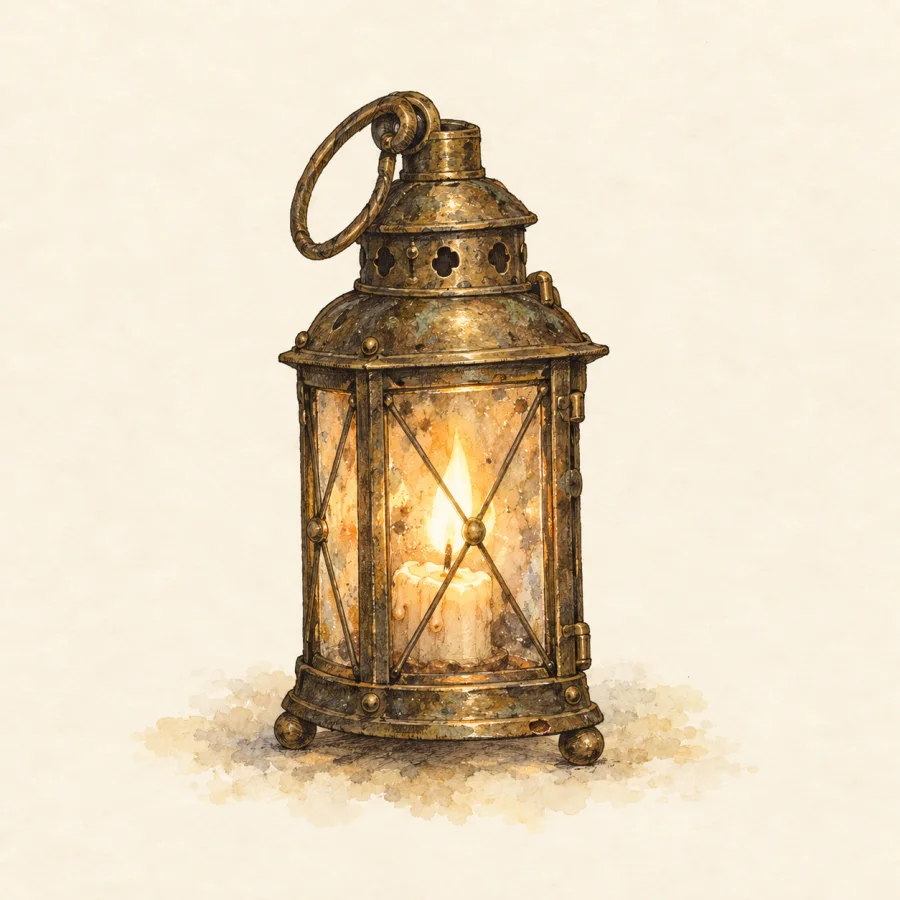
The lantern
Brass, glass, and a small pool of light.
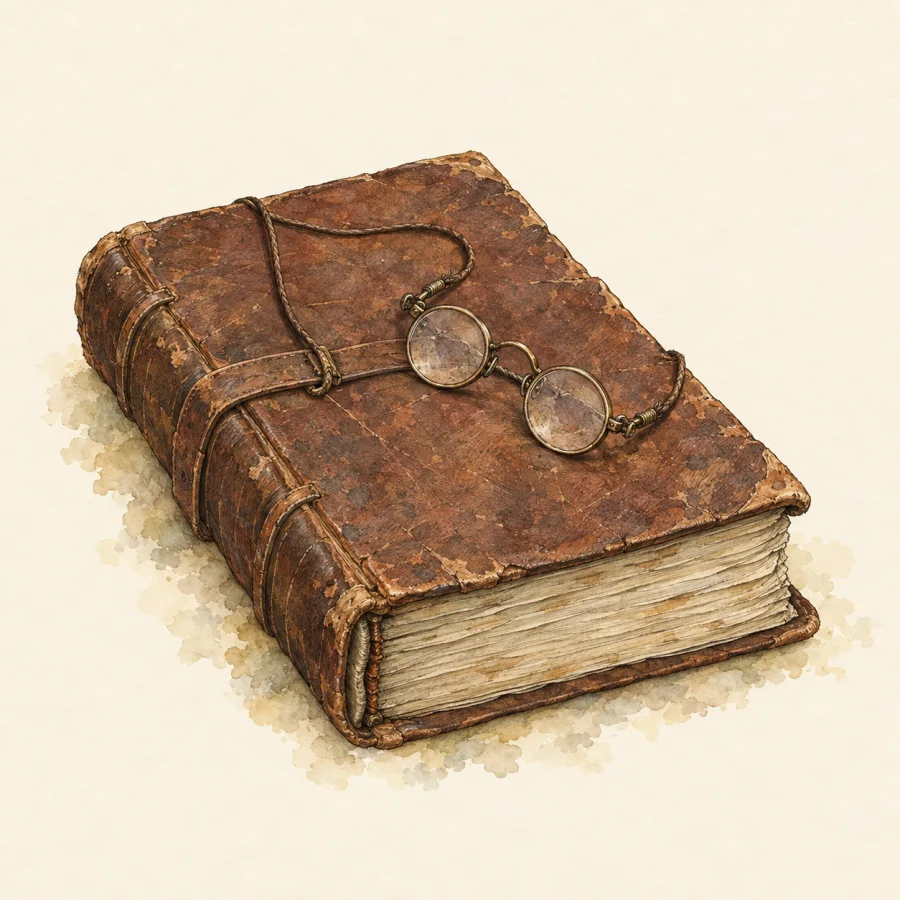
The ledger
A study of Grizel’s book and spectacles.
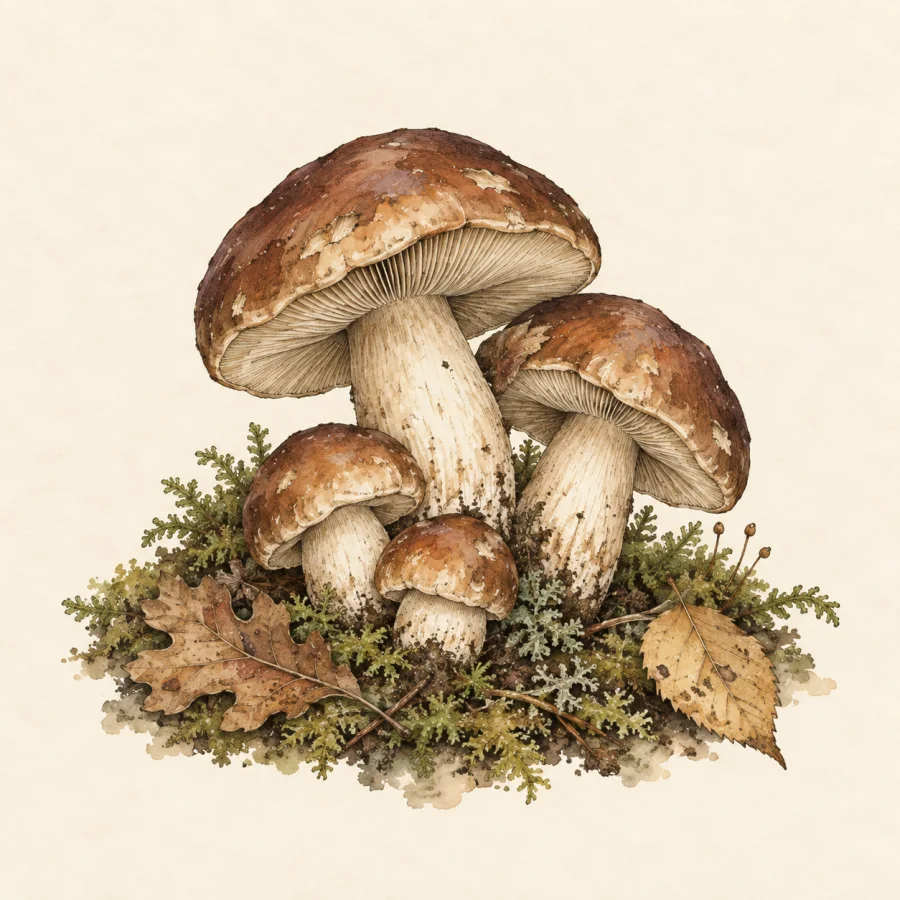
At mushroom height
A few inhabitants of the patch.
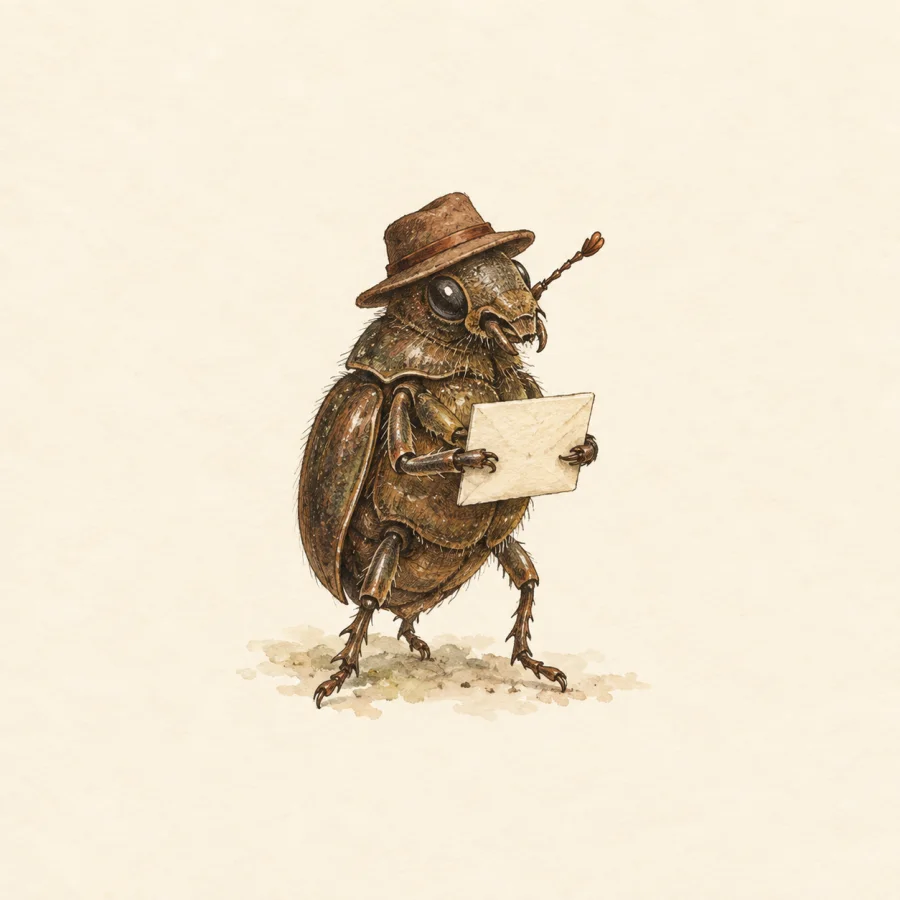
The first post
The letter-carrier as first encountered, with a very small hat.