
Day Seven · Sunday · 25 October 2026
Frost. Two days early. As stated.
The Frost
The frost came in the night, exactly as stated, two days earlier than last year, and in the morning the hollow was a different country. Every mushroom wore a hat of white. The flat stones of the path had gone from grey to silver and rang, faintly, when Mungo's boots went over them. The hedge, which had been a range of green hills, was a range of glass ones, and every twig of it held the light so that the whole wall of it glittered and ticked as it warmed, and up in the tangle the fliskies moved carefully, wings half-furled, in the manner of people crossing a floor they have just polished. Grizel stood at the gate with the ledger closed under her arm and no pen in her hand, which nobody had ever seen, and said, to no one, "Two days early. As stated." And then, quieter: "Nobody listens." And then, because she is Grizel: "It's recorded."
Gnomesby came across the green at nine.
They came in a line, the way grumlins do everything, four of them, in matching hats that had never been folded in their lives and boots that fit. The Provost led, with his ironed beard and his clipboard. Behind him came two grumlins whose whole function, as far as anyone could ever determine, was to be behind the Provost. And behind them came a fourth, a young grumlin with a thin beard and an anxious expression, carrying the Treaty of the Mushroom Patch at arm's length in both hands, the way Mungo carried the lantern, as if it might go off.
And behind him, on a thread of silk, being pulled along the frosted grass on a very small sledge, sat the beetle, in a hat that now had a plume.
"Nobody comes in," said Mungo.
"We are not coming in," said the Provost. "We are here to take possession."
"That's coming in," said Mungo.
There followed an impasse, and it was not yet breakfast, and Grizel, who had been waiting fourteen winters for a hearing under Clause Eleven, announced that since nobody would move, the hearing would be held at the gate, and opened the ledger on the gatepost, and put on her spectacles, and it began.
The Provost read Clause Seven. Grizel read Clause Eleven. The Provost observed that the ledger was not an impartial record. Grizel observed that she had been keeping it for fourteen winters and nobody had ever accused it of being interesting, let alone partial, and there was a sound from the hedge that might have been the frost and might have been every fliskie in the Anunder trying not to laugh at once.
The seals were presented. The Gate: the word "Aye," in Mungo's hand, which the Provost examined for a long time, because he had known Mungo for forty years and had never seen him write anything, and was, anyone could see, shaken by it. The Court: Pettigrew's seal, warm from the collar, which the Provost had not expected at all, because the Court does not seal things for grumlin hollows, and he looked at Pettigrew, who looked at the air a foot above his head, and he said that a seal was only as good as the rank that pressed it, and asked what, precisely, an Adequacy was. There was a silence. Then Grizel, without hurry, turned the ledger back to the first winter, to a page between a recipe for nettle soup and a grudge, and read out the Court's Table of Precedence, which runs, in ascending order: Sufficient, Adequate, Ample, Considerable, Magnificent, and the Oak. Adequate is second from the bottom. Pettigrew had been telling the truth the whole week. She was the lowest envoy the Court could spare, sent to the least important hollow on the least important grievance, and she had stayed the whole week and given her seal to an Occupant, which made her, Grizel observed, turning the page back, the first Adequacy in the history of the Court to have sealed anything at all. Pettigrew did not look at anyone. The ledger records this, and beneath it, in smaller letters: "Promoted, in the only way that counts."
The Ledger: a page in a hand that was not Grizel's, which she turned to without comment and let him read. He read it. He read it twice, in the manner of a man who has been handed a bill and is looking for the error, and he found what he was looking for at the foot of the page, and he put his finger on it, and he asked, in the voice of someone who has found the loose thread and intends to pull it, who this was. Because the ledger, under Clause Eleven, was decisive, and the ledger, for seven days, in Grizel's own hand, had recorded an Occupant, and an Occupant was not a keeper, and whatever the three letters at the foot of the page were, they appeared nowhere else in the book. Grizel said nothing. It was the first time all week she had had nothing to say, and everyone in the hollow heard it.
"It's me," said the Occupant. "It's my name. She told me to write down what happened, and I happened."
It was the most anybody had heard her say in seven days, and it was true, and it was no use whatever, because a name is not a name in the Anunder until the ledger has said it in its own hand, and the Provost knew that as well as she did.
Wick brought the stool. It was, he said, ready. Not nearly. Ready. And the Occupant sat on it, in front of Gnomesby, on the frost, at the gate, and it held, and there was a silence, and Wick said, very quietly, "First time," and took the pen from the gatepost and wrote it in the ledger himself, in the margin, and Grizel let him, and that was, in its way, a signature.
Then the Provost asked his clerk to read Clause Seven into the record, for the form of the thing, and the clerk, who was the beetle, climbed onto the gatepost in its plumed hat and unrolled the treaty and looked at the Occupant for a long moment, the whole of that first night in its small black eyes, the letter, the waiting, the tip that had not come. And the Occupant, who had come into the hollow with nothing but a coat and had spent a week working out what that beetle had been standing on a gatepost for, reached up and twisted off the coat's last button, and set it down in front of the clerk of the opposing party, in full view of the hearing, and stepped back. The beetle looked at the button. It looked at the Provost. Then it read, in a small clear voice that carried across the frost, Clause Eleven, and rolled up the treaty, and left, with the treaty, on its sledge, across the green, and Gnomesby stood at the gate of the hollow with no treaty at all, and Grizel wrote, without looking up, "The beetle has been tipped," and it was at this moment, with the timing of something that has been considering for four days exactly when to stop, that the fox came over the wall.
It had never come through the hedge. It came through now, down the glass hills of it in one long unhurried pour, the frost going off its back in a mist, red and vast and entirely calm, and it walked into the middle of the hearing and turned to face Gnomesby and sat down, and did nothing else whatsoever. On its back, with her legs crossed and her chin in her hands and her moth's wings half-open, sat Tansy, looking at the Provost with an expression of great interest.
The Provost asked what, in the name of Clause Seven, the fox was doing here.
"It has been relocated," said Grizel, writing. "The treaty has no provision for a fox. The fox has no provision for the treaty. The fox is faster." She looked up. "Noted."
The Provost looked at the fox, and at the beetle's sledge disappearing across the green, and at the word "Aye" in a hand he had never seen, and then, being a Provost, he came back to the page, and the three letters at the foot of it, and the fact that the ledger named no keeper, and he was right, and everybody knew he was right, and it was in the middle of everybody knowing it that a biscuit fell from the sky.
It came down out of the white morning end over end and landed on the path between the fox and the Provost with a sound like a small door closing, and half of it was eaten by Mothy before anyone could raise the theological question. Pettigrew ruled it a tribute. Wick ruled it shortbread. And the anxious young grumlin who had carried the treaty and had it taken from him by a beetle and had said nothing all morning looked at the biscuit, and at the Occupant, and said, in the voice of someone stating the obvious to a room that has missed it, "It's for the keeper."
Everyone looked at the biscuit. Then everyone looked at her. And Grizel, before anyone could argue, turned the ledger to the top of the day's page, where it said, as it had said every day for a week, the Occupant, and drew a line through it, once, neatly, and wrote beside it, in her own hand, for the first time, the three letters from the foot of the page.
"Kit," said Grizel, to the Provost, and to the fox, and to the frost. "It's recorded."
The fox, at the word, looked up, in the manner of something that has heard a name it knows and is not going to say from where.1
The Provost signed. He signed in the ledger, under Clause Eleven, that the hollow was kept, and he wrote beneath it, in a small hand, "under protest," and beneath that, smaller, that Gnomesby reserved the right of appeal, and Grizel wrote beneath that, in a hand smaller still, "Noted." And Mungo said, "Nobody comes in," and there was a pause the ledger declines to measure, and he stepped aside.
The mushroom patch was settled afterwards, over what was left of the biscuit. It emerged from the treaty-bearer, under questioning from Nettie that would have broken a fox, that Gnomesby had not taken the mushroom patch fourteen winters ago. The patch had moved. Mushrooms do that. It had crept across the line over three wet seasons, from Gnomesby's side to the hollow's, a row at a time, until it was Nettie's patch with one end of it left on Gnomesby's ground, and Gnomesby had noticed the creeping before Nettie did, and said nothing, and had been quietly farming that end ever since, and had, in fact, been sending a basket of mushrooms every autumn to the compost heap for the old keeper, who had never mentioned it. Nettie heard all this out with her arms folded and her beard entirely silent. Then she said: "So they did take it." And Grizel recorded this as "settled," and underlined nothing, because some things, even in the ledger, are best left to stand.
The beetle came back at dusk, on foot, without the sledge and without the treaty, and stood on the gatepost in its plumed hat and looked at the lantern, and Mothy gave it a crumb, and Mungo, without appearing to move any part of himself, put down beside the crumb a single acorn cap, polished, which is what a grumlin gives when a grumlin gives anything, and the beetle took both, and put the cap on over the plume, and left. Wick's stool is ready. He has started on a table.
1 A kit, the ledger notes, without further comment, is what a fox calls its young. The ledger has been asked about this since, by letter, several times. It has declined to be drawn.
The last page of the week
The ledger has a new page, in a hand that is not Grizel's. She has corrected the spelling. She has not corrected anything else. At the top of the day's page, where it said "the Occupant" every morning for a week, the word has been crossed out, once, neatly, and beside it, in Grizel's hand, is a name, and it is the first thing in the book she has ever written without checking it first, and she says she is not going to check it now.
Pettigrew is still at the gate. It is now a matter of six days. She has been offered a room and has declined it, and has been offered Wick's stool, now that it has held, and has accepted it, and sits on it in the mornings watching the green with the air of someone whose Court has not written to ask where she is, and who has noticed this, and has decided to be insulted about it later, when there is time.
The fox sleeps under the last tree by the old wall, on a white shoe, and every evening a sack goes over the hedge, and nobody looks, and everybody knows, and it is not stealing.
Across the green a lamp is burning late in Gnomesby. The Provost has the treaty open at the clause about appeals, and the beetle is waiting at his elbow, in both its hats.
Mungo was asked, on the last night, what he thought about all of it. He was at the gate. He is always at the gate. He looked at the frost on the path, and the lantern in his fist, and Mothy asleep against his boot, and the hedge going dark above him with the fliskies settling in it like sparks going out, and he said, "Nobody comes in."
And then, after a pause that Grizel, watching from the window, wrote down as one Mungo exactly, he said: "Kit's already in."
And went back to guarding the gate.
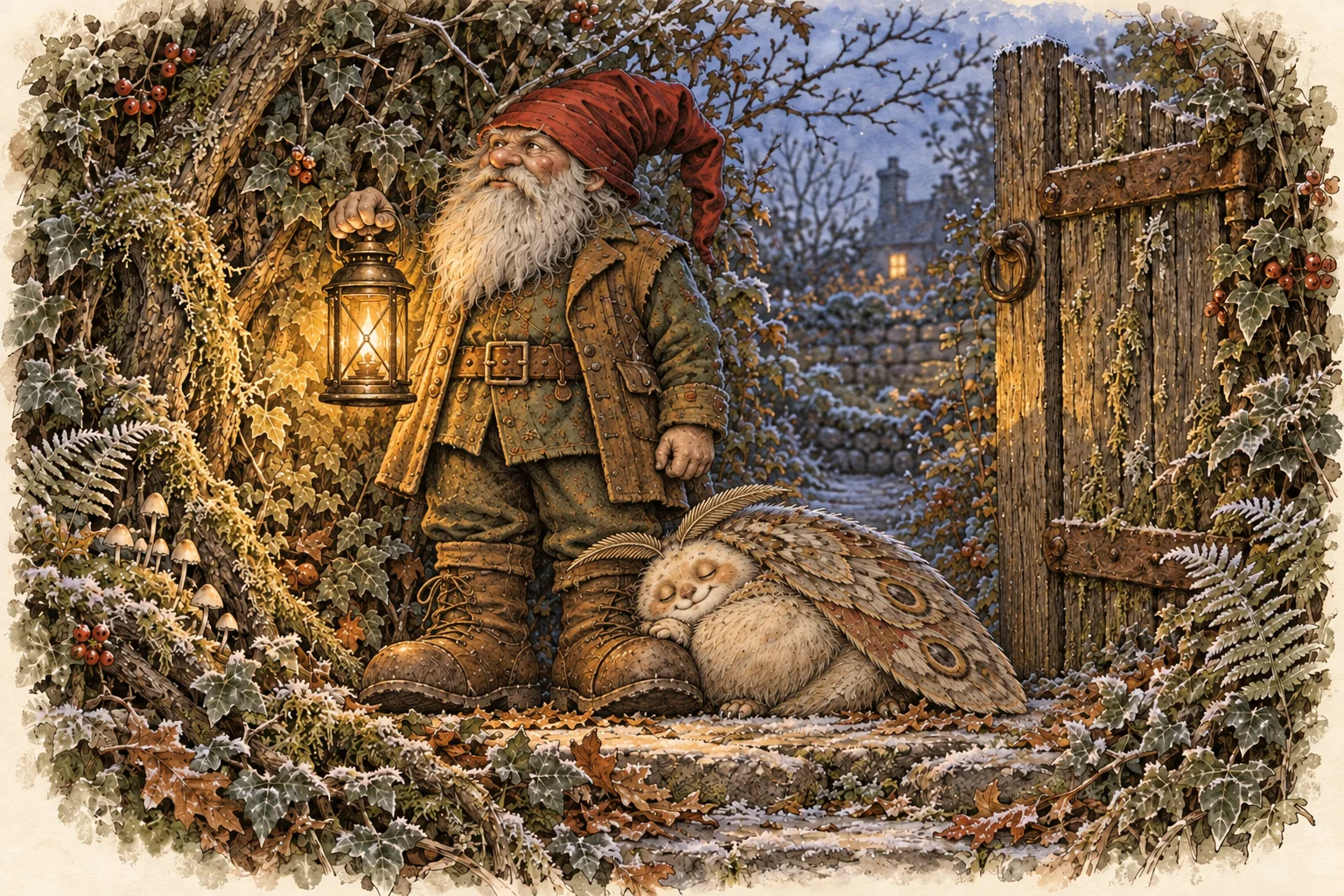
The last night of the week
A closing illustration for the first Sunday.