
Day Twenty-one · Sunday · 8 November 2026
A clean cold morning, the sky scrubbed, as if the Above had got up early and done it.
The Lesson
At eleven o'clock on the third Sunday the Above stopped.
All of it stopped. The boots on the back steps, and the door at the top of them, and the thing inside the Stair that hums, and the long far roar beyond the lane that the hollow has never heard the end of and had always taken for a sort of weather. Grizel had the pen up before the quiet was a breath old. It comes once a year, on this Sunday, at this hour, and she has fourteen of them in the book. By the old reckoning it lasts as long as it takes Nettie to count the beans twice. This year the hollow had a unit, and she timed it, and it came to eleven Mungos, near enough.
Under the figure she wrote what she writes every year: that the theology has never found out what the Above is being quiet at, only that it is the one thing the Above does all together, and the one thing it seems to mean.
Mungo, for the length of it, was unchanged. It may be said that for two minutes in the year the whole of the Above does what Mungo does, and that he has never appeared to find this remarkable.
Then a door banged, and it all began again.
The hearing at midwinter is about a book, and on the third Sunday Grizel decided the keeper had better know what was in it.
She said so at the table after breakfast, with the ledger closed in front of her and both hands flat on the cover, which is how she sits when she is about to open it to somebody, which she never does. Kit sat down on the stool across from her. Pettigrew had given it up for the morning without being asked and had gone to stand at the gate, ten feet from Mungo, looking at the green, and the ledger records this as "tact," and has put a mark beside the word.
"A day," said Grizel, "is entered like this."
She opened the book to yesterday and turned it round.
A day is entered at the top with the day and the weather, because the weather is the only thing that is certainly true, and everything after it is a claim. Then what happened, in the order it happened, in the plainest words the pen will hold. Then what was said, in the words that were said, or as near as a person who was writing them down while they were being said can get, and where the two differ the ledger says so. Then what was recorded, which means it happened, and what was noted, which means Grizel was there and would not swear to the rest. And at the foot, what is nearly ready, and what has not replied, and what is unchanged, because a page that ends on something changed is a page written by somebody who wanted it to.
"And the marks," said Kit.
The marks. One line under a thing means it matters. Two lines mean Grizel is shouting, and she showed Kit the word "oversight" from the third day, with the two lines under it, and said that she had been shouting about the fox, and had been right to, and that the fox had not cared. And there was the small mark in the margin, a hook, no bigger than a fliskie's hand, and Grizel put her finger beside it and said it was for a thing she had decided not to have an opinion about yet. Kit asked how long yet was, and Grizel said that the oldest one in the book was fourteen winters and had not come due, and turned the page before Kit could see what it was beside.
Then she took her back.
The ledger goes back fourteen winters and a little more, and Grizel went through it from the far end, the way you show a person a house by starting in the attic. Here was the recipe for nettle soup, in a hand that was not Grizel's, large and hurried and leaning to one side as if the wind had been behind it: the old keeper's hand, Effie's, from the first winter, when there had been nothing to eat but nettles and a book to write the fact in. The ledger had ruled on that recipe once, Grizel said, when it was disputed, and had found it correct, and Nettie had never forgiven the book, and was not to be asked about the salt on any day of the week, least of all this one. Here, some pages on, was the grudge. Grizel put her hand flat over it.
"A grudge," she said. "Lodged the first winter. Never withdrawn. Its name is not for a Sunday."
Here was the Table of Precedence, between the two, with the six ranks in a column and a small hook in the margin beside the second from the bottom that Kit was almost sure had not been there a fortnight ago. Here was the Treaty of the Mushroom Patch, all thirty-one clauses and the schedule, copied out in the old keeper's leaning hand with Grizel's notes climbing the margins like ivy, and Kit read Clause Seven, and Clause Eleven, and looked at the space between them where, Grizel said, "he thinks the question is, and he may be right, and I have not decided." And here, at the very front, on a page gone the colour of a mushroom's underside, was the first day.
Kit read it. It did not take long.
Rained. Fed the beetle. Mungo unchanged.
She read it twice, the way the Provost reads things, and then she sat back on the stool with the book open in front of her and the whole of the hollow's history between her hands, and asked the question Grizel had not been expecting, which was not about the treaty, or the Table, or the recipe, or the grudge.
"What's the Arrangement?"
She did not say where she had heard the word. The hollow is small, and a word said in the hedge is in the mushrooms by dusk. Grizel did not ask. She sat very still for a moment, like a woman who has walked a guest through her own house and has just seen the guest stop at a door she does not open, and her hand went to her collar, to the place where the beard is tucked in, and stayed there, and pressed, once, as if to be sure of something, and then she said, in the voice she uses for the weather, that the Arrangement was the only agreement in the Anunder that had never been written down, and that this was why it was not in the book, and that they had not finished with underlining.
They had not. Kit let her go back to it.
In the afternoon Kit made an entry.
Grizel gave her the pen. She did not leave the room this time, or go up to bed, or turn her back, or pretend to be looking at the hedge. She sat across the table with her spectacles on and her hands folded and watched, in the way she watches everything, which is to say as if it might need writing down afterwards, and Kit turned to the day's page, under the weather, and wrote.
It was about the slug. It was two lines. It said that the envoy of the slugs had gone out on Monday, six days gate to gate, and had asked for nothing and been given nothing, and that this had been recorded as a success, and that the ledger would like to know what a failure would have looked like. Grizel read it over her shoulder, standing. She read it twice. She corrected nothing. Not the spelling, which she had corrected once before and found today did not need it, not the grammar, not the last clause, which was an opinion, and had no business on a page, and which she looked at for a long time and let stand.
"That'll do," she said, which is Nettie's, and which she had never said before, and knew it.
"You may have the Saturdays," said Grizel.
"Have them for what?"
"The entry. One Saturday in two. I shall correct the spelling." She squared the pen to the edge of the book. "This ledger has been kept in one hand for fourteen winters, and it has lately occurred to the hand that it would like, once in a while, to find out what happened by reading about it."
It was after that, with the book still open between them and the light going long across the table and Mungo at the gate saying nothing in the way that carries, that Kit asked the other question.
"Who does keep it?"
"I do," said Grizel.
"Who says?"
Grizel opened her mouth. She closed it. She opened it again, and closed it again, and between the two there passed a length of time which is not a Mungo, and not a unit of slug, and for which the hollow does not yet have a name, and at the end of it she said nothing, and reached for her spectacles, which were already on, and took them off, and looked at the book without the benefit of clarity for some time.
The Provost's question came across the green in a letter on the eighth day. It has been at the gate ever since, ten feet off, not coming in. Today it came in.
The ledger has been kept for fourteen winters in one hand, and has other hands in it now, and one of them entered a day today with the first hand watching, and nothing was corrected. The book is where it was. The ledger has recorded that, and has not decided who by.1
1 There is a hand in the book that is not Grizel's. It was there on the seventh day, once, at the foot of a page, and she corrected its spelling. It is there again today, under the weather, and she did not. She has looked at the two entries side by side, and the second is easier to read than the first, and she has been trying to decide whether that is because the hand has improved or because she has got used to it, and finds she would rather not know.
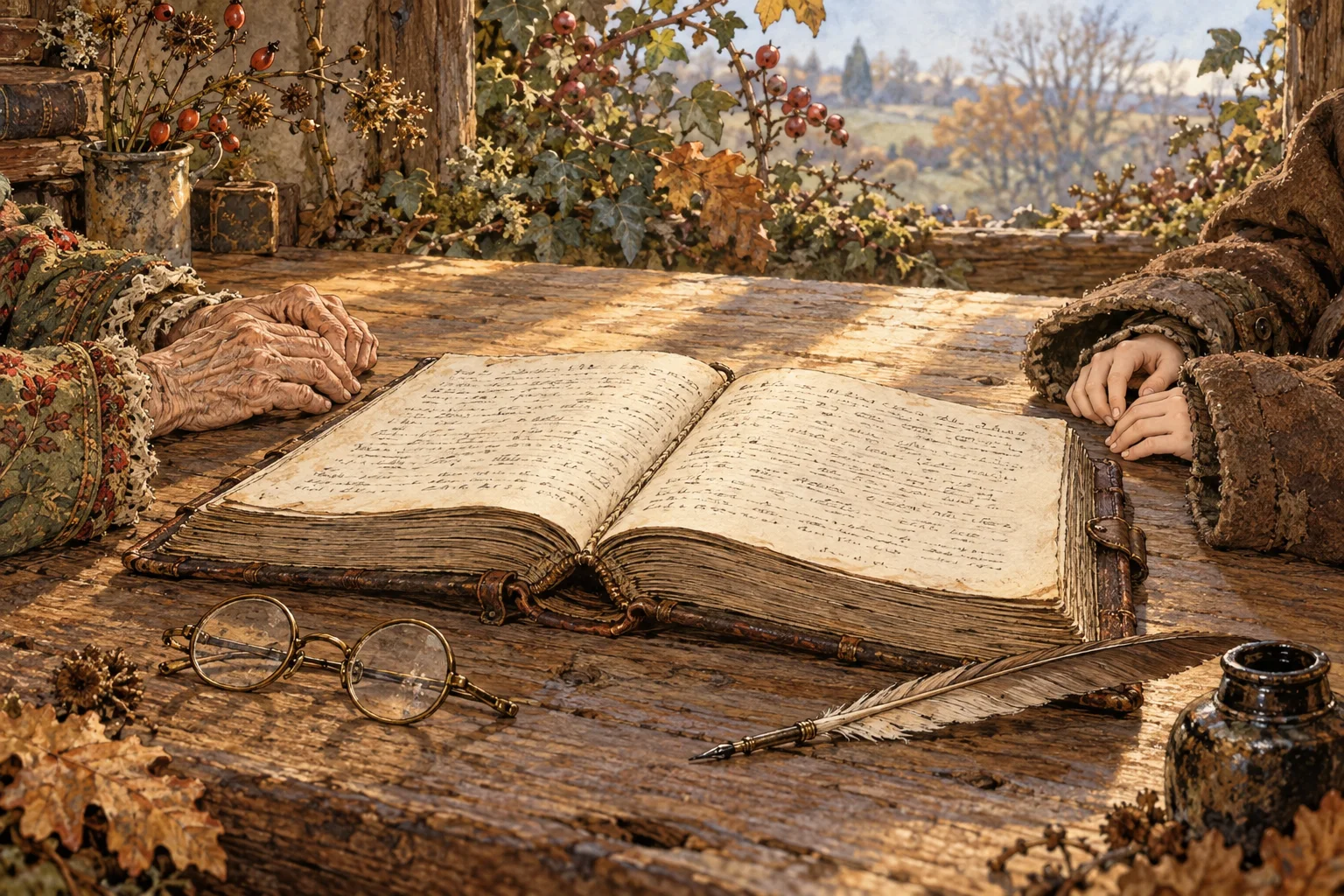
Nothing corrected
A closing illustration for Sunday 3.